






How to Clean Cork Flooring Without Damaging It
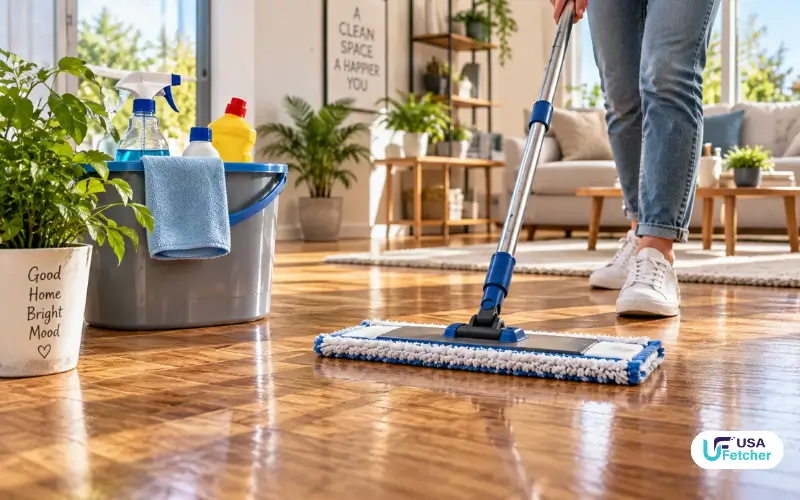
If you’re wondering how to clean cork flooring, the safest approach is to remove dirt and grit regularly, then clean the surface with a lightly damp, well-wrung mop and a cleaner approved for your flooring. It is important to note in the manufacturer’s care instructions that excess water is to be avoided to prevent cork flooring from becoming saturated when being cleaned. AmCork advises regular vacuuming and light cleaning with a damp mop and warns against ammonia-based cleaners. iCork also suggests using a wrung-out damp mop and the proper cork-safe cleaning solutions and says to avoid steam cleaning and soaking the floor. Cork floors can be finished differently and built in various ways, so refer to the flooring manufacturer’s maintenance guidelines before selecting a cleaning product for your floor.
Why Cork Flooring Needs a Different Cleaning Method
Cork flooring is a natural product, but the cleanable surface may be covered with a finish. Depending on the product, that finish can include polyurethane, urethane, acrylic, or wax.
This is important because there are interactions between cleaning products and the protective finish, not only the cork under the finish. One finish may not be compatible with another.
Cork poses another problem of excessive moisture. Damp mopping is a preferred method of cleaning and is often recommended by manufacturers. AmCork, for instance, recommends regular vacuuming and light cleaning using a damp mop and cautions against ammonia-based cleaners. AmCork also suggests using a slightly wet mop and a non-abrasive, pH-neutral floor cleaner with floating cork floors.
Determine the manufacturer, product, type of installation, and the type of finish on the floor (if known) before deep cleaning. When you are uncertain of the finish, don’t try to use strong cleaners or polishing products.
What You Need to Clean Cork Flooring
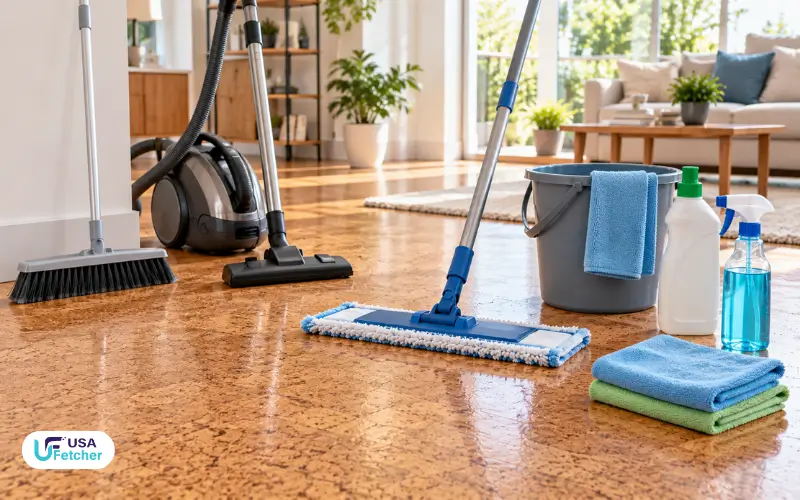
Normal cork floor care doesn’t require a complex mix of equipment.
A practical cleaning setup will consist of:
- Use a soft broom or microfiber dust mop.
- A vacuum that is appropriate for hard floors.
- A microfiber mop
- A floor cleaner manufactured by the flooring company or acceptable to the flooring company.
- Clean water, as specified in the instructions for use of the product.
- Spills and small marks can be taken care of with soft microfiber mops.
Using a vacuum to take grit from edges and other places a dust mop can’t reach can be helpful. When using a vacuum with a rotating brush or beater bar, be sure to read the manufacturer’s directions for your flooring before doing so on the cork surface.
How to Clean Cork Flooring Step by Step
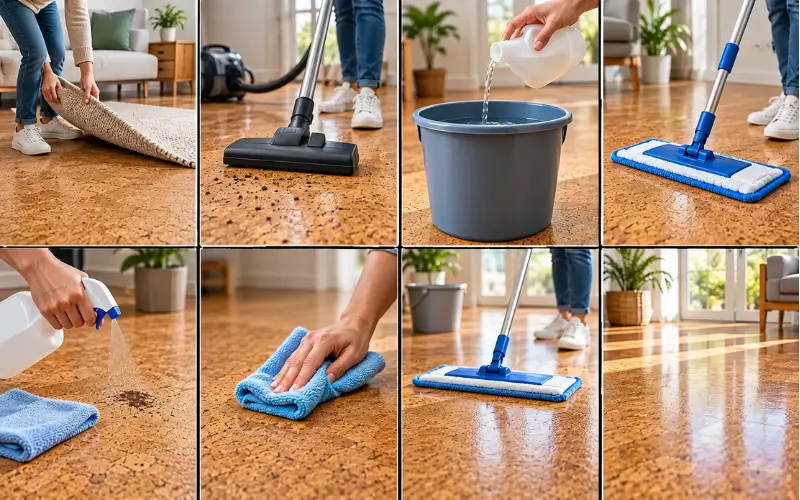
1. Remove Furniture and Floor Mats
Remove furniture and floor mats.
Remove small furniture, objects, and movable mats from the cleaning space.
Avoid dragging heavy furniture across the cork floor. Sharpened objects, heavy concentrations, and broken furniture legs are all elements that can damage cork.
When moving furniture, lift furniture, if possible, or use any other suitable furniture moving technique that will not scratch the floor.
2. Sweep or Vacuum the Floor
It is important to remove loose dirt before adding moisture.
Abrasive because walking on it can cause sand, grit, dust, and other debris to become abrasive. Sweeping or vacuuming regularly not only enhances the cosmetic appeal but also minimizes finish wear.
Note the points especially:
- Entryways
- Around furniture
- Along baseboards
- Under tables
- The areas near outside doors
- High-traffic walkways
AmCork and WECORK both suggest regular sweeping or vacuuming as a part of regular cork-floor maintenance.
3. Choose the Cleaner for Your Finish
Never use the same cleaner as you used for tile, vinyl, or other floors.
Many of these completed cork floors call for a pH-neutral cleaner or a mild wood-floor cleaner. When used as directed, iCork specifies that a pH-neutral wood floor cleaner is safe to use on relevant finished cork floors.
The best way to do this is to read your flooring manufacturer’s care guidelines first.
Always use a homemade formula if the manufacturer recommends one specific product, dilution, or cleaning method.
This is especially crucial in the case of waxed floors. Waxed cork needs to be cared for differently than urethane- or polyurethane-finished cork.
4. Damp-Mop the Cork Floor
Dip the microfiber mop into the cleaning solution of your choice and wring it out.
The mop should not be wet; it should be damp.
Do the work parcel by parcel on the floor. Do not pour a lot of liquid at once throughout the entire room.
The goal is to get rid of surface dirt and residue while keeping the amount of water on the floor surface below what is needed to penetrate seams, edges, or worn floors.
AmCork specifically says never to saturate cork flooring with water when mopping. It is suggested by its maintenance instructions to be damp mopped as necessary.
5. Wipe Up Excess Moisture
Avoid leaving puddles or water-soaked areas behind when cleaning.
Use a clean microfiber cloth or dry mop to remove any excess moisture from a section if it is too moist.
Particularly at joints, edges, transitions, and where the protective finish has worn away.
Cork floor maintenance isn’t so much about the quantity of cleaning solution used, but more about the amount of moisture that gets to the surface of the cork.
6. Allow the Floor to Dry
Do not allow unnecessary traffic in the area while the floor is drying.
If there is still moisture on the surface, do not replace rugs or move furniture back to its place.
If damp cleaning is not drying the floor after watering continuously for a longer period, decrease the quantity of damp cleaning solution and check with the manufacturer’s cleaning guidelines.
Cork Flooring Cleaning Methods Compared
| Cleaning Method | Suitable for Routine Care? | Main Consideration |
| Soft broom or microfiber dust mop | Yes | Good for removing loose dirt and grit |
| Hard-floor vacuum | Yes | Use an attachment/settings appropriate for the floor |
| Damp microfiber mop | Yes | Keep moisture controlled and avoid saturation |
| pH-neutral wood-floor cleaner | Often | Confirm compatibility with the floor’s finish |
| Excess water or soaking | No | Can expose the floor to unnecessary moisture |
| Steam mop | Avoid | Manufacturer guidance for cork commonly advises against steam cleaning |
| Abrasive scrubbers | No | Can damage the protective finish |
| Oil-based floor soaps | Avoid unless specifically approved | Can be incompatible with modern finishes |
| Ammonia-based cleaners | Avoid | AmCork specifically warns against them |
| Wax products | Finish-dependent | Do not use wax on urethane-finished floors |
The table is designed to be conservative, as not all cork flooring products are finished or built in the same manner.
How Often Should You Clean Cork Flooring?
The best cleaning schedule cannot be one-size-fits-all.
What you need to do is differentiate between dry cleaning and damp cleaning.
Regular Dry Cleaning
Sweep or vacuum regularly to avoid the build-up of dirt and grit.
If you have children, pets, several people living in the house, or lots of foot traffic, you might have to dry clean the room more often than a single person in a single bedroom.
Entryways are often more demanding, as more outdoor dirt is likely to get onto the floor in this area.
Damp Cleaning
When the floor requires more than dry cleaning, damp-mop.
Frequency is influenced by traffic, room usage, spills, and soil or contamination that is visible. Don’t follow a set weekly schedule unless it is different from the manufacturer’s recommendations.
The key is to use controlled moisture and the proper cleaning solution.
How to Clean Cork Flooring After a Spill
Clean up spills promptly if possible.
First, use a clean and soft cloth to absorb the liquid. Avoid spreading the spill by rubbing it vigorously.
After the liquid is removed, clean up any residue with the approved cleaning product for the floor.
Do not use heavy stain remover right away to clean food, liquids, mud, or other materials. Increased strength of a chemical does not necessarily make it safer or more effective for cork.
When the spill has gone into a defective seam or worn floor, and the floor starts to swell, discolor, or separate, cleaning may not be the right choice. That condition can be assessed by evaluating the finish or flooring.
How to Deal With Scuffs and Stubborn Marks
Use the mildest intervention first.
Use a soft microfiber cloth and the cleaner suggested for the finish of your floor. Use light pressure and don’t scrub too hard.
Never use steel wool, gritty powder, abrasive pad, or sharp object to remove a stubborn mark.
In maintenance instructions, iCork cautions against using abrasive mixtures and steel wool, and AmCork also advises the use of non-abrasive materials.
If a mark is not removed by light cleaning, it could be surface dirt. It could be damage to the finish or the cork itself.
It is then that further scrubbing may exacerbate the issue.
What Not to Use on Cork Flooring
There are some common floor cleaning practices that can be harmful to cork.
Avoid Steam Mops
Steam cleaning adds heat and moisture to a flooring system, which some manufacturers may indicate is a job you should not steam clean.
Steam Cleaning is on iCork’s list of the ways to avoid when caring for cork floors.
Avoid Excessive Water
Don’t think of a mop that’s soaked in the same way as a mop that’s damp.
Don’t leave puddles or water around the floor. The use of water to soak cork flooring is specifically discouraged by AmCork.
Avoid Ammonia-Based Cleaners
AmCork says they do not recommend using an ammonia-based cleaner or chemical on their cork floor.
Never presume a household cleaner, labeled as such, will be suitable because it states it can be used on several different hard surfaces.
Avoid Abrasive Cleaning Products
It can be worn or scratched by scouring powders, abrasive pads, steel wool, etc.
Cork needs to be cleaned gently and not scrubbed aggressively.
Avoid Oil-Based Soaps Unless the Manufacturer Approves Them
This is particularly relevant and significant.
There are oil-based traditional wood-floor cleaning products available. Further, iCork cautions against using oil soaps like Murphy’s Oil Soap when caring for iCork cork flooring since these can strip finishes.
The best rule of thumb is to take the cleaner’s advice for the specific type of floor rather than believing that if it says it’s good for wood, it’s good for cork!
Do Not Use Wax on the Wrong Finish
The maintenance of a wax is dependent on the flooring system.
According to WECORK, wax should not be used on its urethane/Greenshield floors, and its waxed cork floor requires a special wax maintenance procedure.
So don’t wax the floor just because it has a dull appearance. Find out the floor finish to begin with.
How Finish Type Changes Cork Floor Care
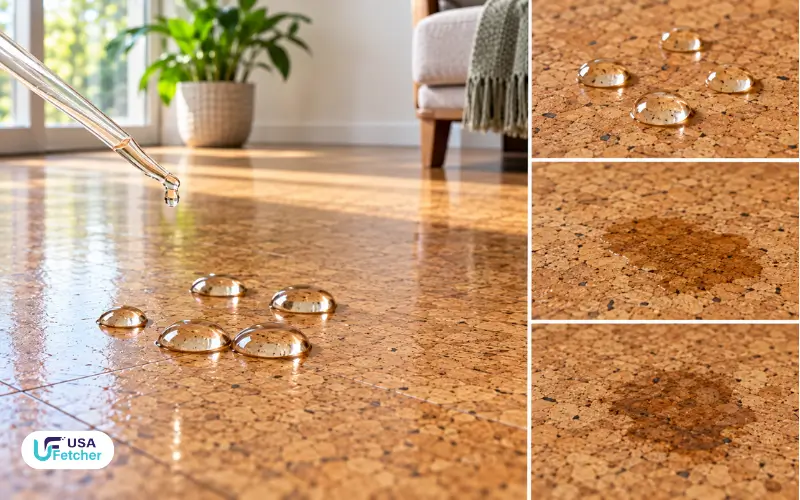
Polyurethane or Urethane-Finished Cork
Most of today’s cork products have a protective urethane or polyurethane coating.
Typical maintenance of these floors involves regular dry cleaning and controlled damp cleaning using cleaners specific to wood floors.
Don’t assume that a wax will give the finish any better. WECORK states expressly that they do not recommend waxing their urethane/Greenshield floor.
Wax-Finished Cork
This is because waxed cork will need a different approach to care.
Within WECORK’s maintenance system, quality paste wax and buffing are required for the maintenance of the waxed flooring.
This isn’t to say that all cork floors should be waxed. First, make sure that the floor is meant to be waxed.
Floating Cork Flooring
Floating cork floors must be installed following the manufacturer’s guidelines.
iCork recommends a similar approach for a floating cork floor as used for hardwood floors: mop using a slightly damp mop with a non-abrasive, pH-neutral floor cleaner, and do not use aggressive floor cleaning products.
AmCork also recommends that floating cork flooring be damp-mopped as necessary and not soaked.
Glue-Down Cork Tiles
There are different moisture and finishing needs for glued-down cork products than floating floors.
In moisture or high-use areas, some glue-down systems can be sealed or recoated for extra protection.
Since construction and finish vary, follow the product-specific maintenance instructions, not presuming that a glue-down floor requires the same maintenance as a floating floor.
How to Protect Cork Flooring Between Cleanings
Good maintenance begins when dirt does not get onto the floor.
Use suitable walk-off mats at entrances to minimise the amount of grit tracked onto the cork. But if you are looking at mat backing, you should consult the recommendations of the flooring manufacturer. WECORK does not recommend rubber-backed or non-ventilated mats because they can hold moisture.
Furniture protection is important, too.
Ensure furniture is protected with appropriate felt or other manufacturer-recommended protection under furniture legs. Both WECORK and AmCork suggest protection under furniture as well as wheeled furniture.
Never slide heavy furniture or appliances over a bare cork floor.
Cork can also be damaged by direct sunlight. AmCork and WECORK point out that prolonged light exposure can affect the colour or lighten the cork; therefore, window coverings or other suitable UV protection measures could help to minimise exposure.
When Cork Flooring Needs More Than Cleaning
Despite the fact that cleaning can resolve some issues with flooring, it is not the solution to all.
If you have noticed any of the following, consider professional assessment or manufacturer’s advice:
- Raised edges or seams
- Buckling
- Deep scratches/gouges
- Complete peeling or separation of finished product
- Persistent discoloration
- Water damage
- Where the protective finish has been worn away.
Refinishing is discussed in WECORK where wear is evident, and in AmCork a separate instruction on recoating cork flooring is provided for a few applications.
Never try to sand, strip, or refinish aggressively just because the surface is not looking the way it did before with regular cleaning. The existing finish and flooring construction must be pinpointed first.
A Simple Cork Floor Cleaning Routine
In most cases, the finished cork floor treatment can be kept to a minimum:
Every day or as needed: Remove loose dirt, dust, and grit with a soft broom, microfiber dust mop, or suitable vacuum.
When spills happen: Use a soft cloth to quickly remove any spills.
When the floor needs wet cleaning: Clean with the recommended floor cleaner and damp mop the floor with controlled moisture.
After damp cleaning: Absorb excess moisture and let the surface dry.
For long-term protection: Employ appropriate entrance mats and furniture protectors and adhere to the manufacturer’s maintenance and refinishing instructions for the floor.
It is important to be consistent, not aggressive. Removing the grit regularly and carefully managing moisture levels means less wear and a clean-looking floor.
Conclusion
Understanding how to clean cork flooring starts with using a gentle and controlled maintenance routine. The first step in cleaning cork flooring is to select a gentle maintenance process that is carried out in a controlled manner. Sweep or vacuum frequently to pick up any abrasive grit; clean up spills quickly; and use a well-wrung damp mop with a cleaner that is suitable for the type of floor finish. Do not use any soaking, steam cleaning, abrasive products, ammonia-based cleaners, or unapproved oil soaps. Before selecting a maintenance product, most importantly, know if your floor is a polyurethane, urethane, wax, or other finish. Caring for cork flooring according to the manufacturer’s instructions is the best way to keep your cork floor clean and ensure that it will remain looking great for a long time to come.
Must Read: eeBoo English Flower Shop Puzzle Review: Size, Features, Artwork
Apple Park Park Friend Paloma in lavender : Features, Materials
Frequently Asked Questions
Can you mop cork flooring?
Yes. Clean the floor with a damp mop, but do not pour water on the floor.
Can you use a steam mop on cork flooring?
No, not at all, unless the manufacturer of the floor material has specifically stated that steam cleaning is acceptable.
What is the best cleaner for cork flooring?
Most often, a mild or neutral floor cleaner recommended for your particular cork floor will be suitable.
Can you use vinegar to clean cork flooring?
Unless the flooring manufacturer states that it should be used on your floor’s finish.
Can you use Murphy’s Oil Soap on cork floors?
Unless specifically recommended by the manufacturer for use with their cork flooring product, it should be avoided.
How do you clean cork flooring without damaging it?
Scrub and remove dirt, use an appropriate cleaner, damp-mop lightly, use only a little water, and do not use abrasive products.
How do you clean cork flooring with a polyurethane finish?
Sweep or vacuum first, then follow with a damp mop using a cleaner recommended for use on polyurethane.
Can you wax cork flooring?
Yes, but only if it is a wax maintenance finish as indicated by the flooring manufacturer.
How often should cork flooring be cleaned?
Regularly sweep or vacuum and damp-clean the floor when dirt collects or is visibly present.
How do you remove spills from cork flooring?
Clean up any spills promptly using a soft, absorbent paper towel, and then use an approved floor cleaner to clean up any remaining residue.