





Market Street San Francisco: History, Landmarks, Transportation & Visitor Guide
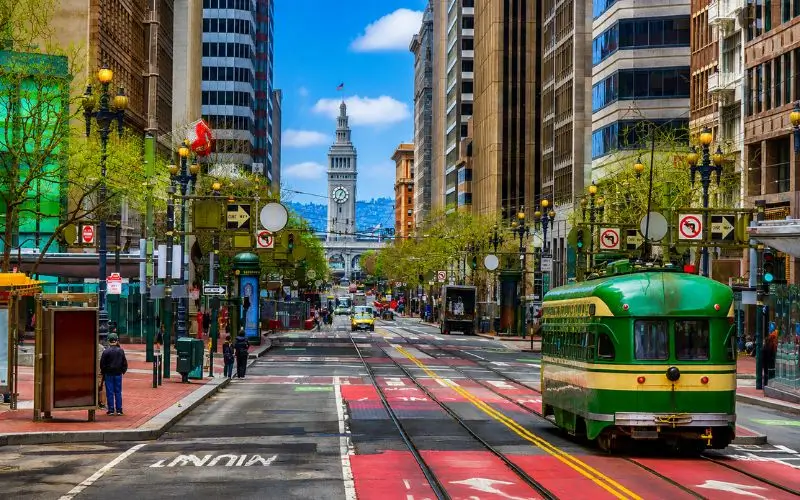
Market Street in San Francisco is one of the city’s most important streets. It links the Financial District, the Ferry Building, Union Square, and Civic Center. The street is a significant transit corridor for Muni, BART, and the old streetcars. It also houses offices, shops, restaurants, hotels, and public spaces. Another popular destination on the list of places to look for in San Francisco is 333 Market Street, which is a prominent office building in the Financial District. This guide offers insights into the history of the street, local transportation, nearby attractions, and travel advice based on information from official sources.
Quick Overview of Market Street San Francisco
| Feature | Details |
| Location | Downtown San Francisco, California, USA |
| Starts At | The Embarcadero (near the Ferry Building) |
| Ends At | Portola Drive |
| Length | Approximately 3 miles (4.8 km) |
| Known For | Business district, public transit, shopping, and historic landmarks |
| Major Areas | Financial District, Union Square, Mid-Market, Civic Center |
| Public Transportation | BART, Muni Metro, Muni buses, F Market & Wharves streetcars |
| Popular Landmark | Ferry Building |
| Nearby Office Building | 333 Market Street San Francisco |
| Best Time to Visit | Weekday mornings for business visits or weekends for sightseeing |
| Suitable For | Tourists, commuters, business travelers, and shoppers |
| Official Project | Better Market Street Project |
Where Is Market Street San Francisco?
Market Street is a central street of San Francisco, California, USA. It runs from The Embarcadero, directly across from the Ferry Building, southwestward for approximately 3 miles (4.8 km) to Portola Drive in the vicinity of the Twin Peaks area. It runs through some of the city’s most vital neighborhoods such as Financial, Union Square, Mid-Market, Civic Center, and the Castro District, and is one of the city’s primary transportation and commerce corridors.
How to Reach
It’s easy to get to Market Street in San Francisco, due to the fact that it is the primary transportation route in the city. The simplest route is by BART, which has four stations in downtown, all on Market Street: Embarcadero, Montgomery Street, Powell Street, and Civic Center/UN Plaza. Each of these stations offers easy access to areas of the street.
Market Street is served by the Muni Metro service and historic F Market & Wharves streetcars, along with several Muni bus services, so it’s quick and convenient to get to major attractions, offices, and shopping.
From San Francisco International Airport (SFO), visitors can go straight downtown on BART, then board the line at the San Francisco station nearest to their destination on Market Street. This is typically the quickest and simplest alternative.
Most of Market Street is focused on walking, cycling, and public transportation, so choose a nearby public parking garage if you are traveling by auto. Parking is available all over downtown, but availability and fees differ. Parking information is subject to change before your visit and is recommended to be checked.
Understanding 333 Market Street San Francisco
One of the numerous office buildings along the corridor is 333 Market Street San Francisco, a prominent office building in the Financial District.
Most attractions are not located at the address; instead, it is mainly professional offices and businesses. It is located in the downtown area and is easily accessible to:
- BART stations
- Muni transit services
- The Ferry Building
- The Embarcadero
- Hotels
- Restaurants
- Financial institutions
Individuals may be among the tenants, so please double-check current businesses or office suites with the building management or the company you will be visiting before you travel.
Why Market Street San Francisco Is the City’s Main Thoroughfare
Market Street is unique among San Francisco’s streets in that it runs diagonally across the city’s street grid. The design was initiated at the beginning of city planning and helped to link neighbourhoods together and provided a wide avenue for traffic and trade. The corridor is still open today, stretching from Steuart Street near the Embarcadero to Portola Drive, but the most heavily traveled downtown portion is between the waterfront and Octavia Boulevard.
It has several reasons for its significance:
- It is a significant street for Muni buses, light rail, and historic streetcars.
- Several BART stations are found on the street or close to it.
- It links the Financial District and Union Square, Civic Center, Mid-Market, and various other districts in the city.
- It houses government structures, office buildings, hotels, restaurants, cultural centers, and shopping centers.
Market Street is not like a regular commercial thoroughfare but rather a transportation and civic artery that connects a number of the most popular neighborhoods in San Francisco.
A Brief History of Market Street in San Francisco
In 1847, during San Francisco’s early growth, city planner Jasper O’Farrell surveyed Market Street for the first time. The street plan around the street was not adjacent to the street itself, but rather the street was intentionally designed to be a grand boulevard that would provide a connection between the various parts of the expanding city.
In the late 19th century, the street became:
- the main shopping street of the city,
- a horse-car and subsequent cable-car railway terminus,
- Features renowned hotels, theatres, banks, and government buildings.
After the San Francisco earthquake and fire of 1906, the neighborhood was rebuilt, and Market Street was again the hub of the city’s recovery and growth. Over the 20th century, it continued to grow and develop with the introduction of new transportation technologies—from streetcars and buses to underground BART infrastructure and the introduction of modern Muni Metro service.
The corridor is still evolving today through the Better Market Street Project, a project spearheaded by the SF Public Works in collaboration with various agencies, including SFMTA, SFPUC, SFCTA, and BART. The project emphasizes safety, accessibility, transit reliability, streetscapes, and aging infrastructure. \
Major Districts Along Market Street
Market Street is one of the reasons why it has millions of residents, commuters, and visitors every year because of the diversity of neighborhoods it spans.
The Embarcadero and Ferry Building
The east end of Market Street starts near the San Francisco waterfront. The iconic Ferry Building is still a major landmark in the city, featuring restaurants, specialty food stands, and local ferry service.
Financial District
From there, Market Street runs to the west through the Financial District, where numerous national and international corporations have their offices. This area is one of the most active areas of downtown, featuring numerous modern office towers, hotels, and transit connections.
Union Square Area
North of Market Street is Union Square, a center of San Francisco’s shopping and hospitality sector. It is easy to get from the two areas.
Civic Center
Further west, the corridor extends to Civic Center, where several key public institutions, such as San Francisco City Hall and major performing arts spaces, are located.
Mid-Market
There has been a lot of investment, both public and private, in Mid-Market in the last 10 years. Although the commercial nature of the space has shifted over the last few years, the city has continued to seek improvements in the transportation infrastructure, safety of pedestrians, and improvements to public spaces.
Transportation on Market Street
Market Street has been about transportation from the beginning.
There are several ways to get to the corridor by public transport today:
- Muni Metro
- Historic F Market & Wharves streetcars
- Muni bus routes
- BART regional rail
- The foot and bike path network.The network of footpaths and bicycles.
- Regular ferries from the Ferry Building
The Better Market Street project is intended to enhance the reliability of the transit service and to make the corridor safer for people walking and biking by installing new signals, curb ramps, bicycle facilities, landscaping, and making the corridor more accessible.
Market Street is one of the busiest multimodal transportation corridors in Northern California, due to the way that so many transit services converge here.
Accessibility Features
One of the key areas of focus for the Better Market Street Project is accessibility improvements.
Verified improvements include:
- ADA-compliant curb ramps
- Rebuilt crosswalks
- Larger islands for transiting en route
- Sidewalk improvements
- Replacement of uneven pavement
- Reduced crossing distances at key intersections within the area
- Broader and better traffic signals and streetscape elements
These enhancements are designed to afford a safer and more convenient experience for pedestrians, wheelchair users, families with strollers, older citizens, and transit users.
Parking Near Market Street
There is a variety of parking options available in all parts of downtown San Francisco, but they are not guaranteed.
Several important points should be kept in mind by visitors:
- Much of Market Street is a transportation and pedestrian/bike-friendly street.
- Mostly parking will be located in nearby public garages or private parking facilities, rather than on the corridor.
- There is no standardisation in parking availability, cost or operating procedures throughout the area.
Parking fees are subject to change, and you should check with the parking operator before coming to the area. This information can not be proved to be representative of all parking facilities.
Dining Along the Corridor
Market Street runs through several business centers, providing numerous different restaurants.
Visitors can find:
- Coffee shops
- Casual cafés
- Fast-casual restaurants
- Fine dining
- International cuisine
- Bakeries
- Food halls
- Hotel restaurants
Market Street is not a restaurant itself but a way to get from one of the best restaurant neighborhoods in San Francisco to another.
Shopping Around Market Street
There are opportunities for retailing in different parts of the corridor.
Some popular shopping areas are:
- Union Square retailers
- Businesses in the Westfield region (if there are any)
- Independent downtown retailers
- Convenience stores
- Specialty food stores close to the Ferry Building
Occupancy of retail space is subject to change, and shoppers should check the details before making a special visit.
Visiting 333 Market Street San Francisco
The 333 Market Street San Francisco building is one of the “new” office buildings in the Financial District that has captured the interest of many online users.
The property is not a tourist facility; it is mainly used as a commercial office building.
It is situated with several practical advantages:
- Very close to the waterfront on Embarcadero
- Easy transportation to area transit.
- Within walking distance of many restaurants
- Close to main hotels
- Near banking/financial services
- Easy access to downtown business meetings
Tenants of the building are subject to change; please check with the business you are looking to visit for up-to-date tenant details.
Comparison: Market Street vs. The Embarcadero
| Feature | Market Street | The Embarcadero |
| Primary purpose | Civic, business, and transit corridor | Waterfront boulevard |
| Transportation | Muni, BART, buses, streetcars | Streetcars, ferries, walking, cycling |
| Business activity | High concentration of offices | Tourism, dining, recreation |
| Shopping | Downtown retail and nearby Union Square | Specialty shops and Ferry Building |
| Best for | Commuters, business travelers, city exploration | Scenic walks, waterfront attractions, sightseeing |
Practical Visitor Tips
Here are some of the recommendations you should consider before visiting Market Street:
- Take advantage of public transit where possible.
- Wear comfortable walking shoes as lots of attractions are within walking distance.
- Provide additional travel time during weekday commuting hours.
- Please refer to official transit agencies for alert information before travel.
- If visiting the business address at 333 Market Street San Francisco, do check the area from time to time as the space might be occupied by another tenant.
Useful tips for visitors to make the best of one of the most congested urban roads in SF, and benefit from the city’s extensive transit service options.
Market Street’s Role in San Francisco’s Economy
Market Street has been one of the key commercial arteries of San Francisco ever since its inception. It connects to the largest employment, government, financial, hotel, cultural, retail, and regional transit hubs in a fairly small space. The corridor is a key area in the urban economy of the downtown area.
Market Street is home to several industries, such as:
- Funding and professional services
- Technology companies
- Hospitality
- Government agencies
- Healthcare organizations
- Retail businesses
- Restaurants and cafés
Thousands of people also travel through the corridor daily on Muni, BART, and regional transit services to their jobs throughout downtown San Francisco.
Ongoing Improvements to Market Street
Market Street is being improved for the long-term through the Better Market Street Project, a joint effort between the San Francisco County Transportation Authority, BART, the San Francisco Planning Department, the San Francisco Public Works, SF Public Utilities (SFPUC), and the San Francisco Municipal Transportation Authority (SFMTA).
The project addresses the purposes of modernizing aging infrastructure, as well as enhancing the overall experiences for all who use the corridor.
Key improvements include:
- Replacement of aged underground utilities.
- Upgrading streetcar tracks
- Installing new traffic signals
- Repaving portions of the roadway.
- Enhancing ADA-compliant features
- Improving pedestrian crossings
- Enhancing bicycle infrastructure
- Increasing transit reliability
- Landscaping and provision of public facilities where appropriate
Better Market Street is not one construction project – it’s a series of projects implemented as funding and construction schedules allow. As per official project info, the completed and future phases will be designed to make the corridor a safer, more accessible, and more transit-friendly roadway.
Is Market Street Worth Visiting?
Most people would respond with yes, but what they are expecting should be commensurate with why they are there.
Market Street does not have a traditional appeal as a tourist destination. Rather, it is a hub of connections for many of San Francisco’s most popular destinations. It’s a popular starting point for tours and sightseeing due to its convenient transportation links and its closeness to iconic sites.
It’s particularly good to take if you intend to:
- Head to the Ferry Building. Go to the Ferry Building.
- Take a stroll on the Embarcadero.
- Explore Union Square
- Go to business meetings in the city centre
- Access BART or Muni
- Visit the offices like 333 Market Street San Francisco
- Experience San Francisco’s historic streetcars
People who want to go to the beach, parks, or residential areas will usually go past Market Street to the other areas of the city.
Conclusion
Market Street in San Francisco is known as one of the city’s main streets and is the heart of downtown. It links key business centers, public transport hubs, shopping areas, and tourist attractions in a single corridor. From 333 Market Street in San Francisco, the street has several great destinations at its fingertips: from BART and Muni access to local landmarks. The street continues to be improved to be safer, more accessible, and better for everyone—residents, commuters, and visitors.
Must Read: King Street Charleston: Complete Guide to Shopping, Dining & Historic…
Credit Repair Huntington Beach: Expert Solutions for Better Credit
California High Desert State Prison: Facts, Location, Visitation & Programs
Frequently Asked Questions
Where does Market Street begin and end?
Market Street runs from Steuart Street near the Embarcadero west to Portola Drive; the hottest part of downtown is between the water and Octavia Boulevard. This Better Market Street Project is limited to the street between Steuart Street and Octavia Boulevard.
What is 333 Market Street San Francisco?
333 Market Street San Francisco is a commercial office building that is situated in the Financial District of the city. It mostly contains business offices and not touristic attractions. Visitors should check the office directory for updates, as tenants can change.
Is Market Street accessible by public transportation?
Yes. Market Street is the main transit artery in San Francisco, and is served by Muni Metro, Muni bus routes, historic F Market & Wharves streetcars, and several BART stations.
Is Market Street walkable?
Yes. Market Street is a very pedestrian-friendly street with wide sidewalks, lots of intersections, transit stops, and links to adjacent neighborhoods. There are still ongoing public works projects, and they are continuing to enhance pedestrian accessibility and safety.
Are there hotels and restaurants near Market Street?
Yes. Within walking distance of Market Street are a variety of restaurants, cafes, and shopping areas, including several of the hotels in downtown San Francisco. Businesses may be subject to change over time, and it is best to verify beforehand the businesses’ locations.
Is Market Street San Francisco safe to visit?
Yes. This is a crowded, pedestrian, and public transit-frequented downtown. Keep an eye on what’s going on around you, particularly at night.
What is the best way to explore Market Street San Francisco?
The easiest mode of transport to explore the area is walking, or taking BART, Muni Metro, or the F Market & Wharves streetcar.