






Tire Shine: How to Get a Clean, Glossy Finish Without the Mess
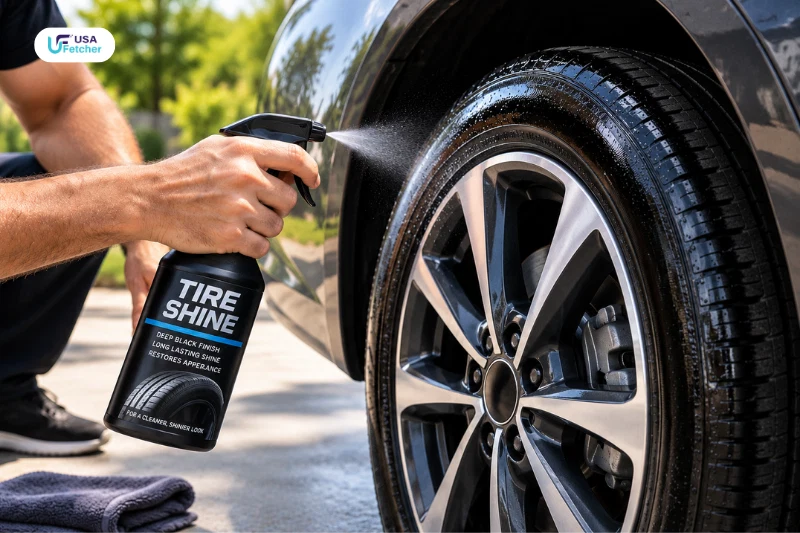
While the ability to spray a product onto the rubber can provide a cleaned-up look, it is not a deep clean. While the vehicle can look noticeably better when the tires are cleaned, it is not a deep clean. Tire shine products are used to make tires look their best and can come in a variety of finishes, from natural satin to high shine and wet look.
The correct result will rely on many factors such as the cleaning of the tire, the dressing applied, the amount of product applied, and the amount of time left to dry. However, if too much product is applied, the familiar issue of tire sling can occur, as the wheel turns and the product is thrown onto the adjacent parts.
This guide covers the basics of what tire shine is, how it works, the different formulations, how to use it properly, how to prevent sling, and the importance of tire safety before using any dressing.
What Is Tire Shine?
Tire shine is a detailing product that is mainly used to enhance the look of the tire rubber, especially the sidewall rubber. It’s also known as tire treatment.
Tires can lose their dark color after they are used for driving. By cleaning, that contamination is eliminated, and using a tire dressing, the sidewall can be given a darker and more finished look.
There are several formulations and finishes of tire shine products. Some are intended to give a light factory look; others for a more prominent shiny finish. Various products may vary in their chemistry, application technique, drying properties, and washability.
Separating appearance from tire maintenance is crucial. Dressing cans do not repair damaged rubber, restore worn-down tires, correct under- or overinflation, or render an unsafe tire safe. The National Highway Traffic Safety Administration suggests frequent checks, proper air pressure, and checking tread and condition.
What Does Tire Shine Do?
The obvious function of wear on the tyre is to make the tyre look darker and cleaner.
The dull appearance of a tire sidewall that has been subjected to road dirt and weather can make a vast difference once cleaned and dressed. The product may give a matte, satin, semi-gloss, or high-gloss finish depending on the formulation.
Certain tire dressings contain components designed to protect the surface of the tires. These properties, however, differ from product to product. Once a manufacturer claims a product, this does not automatically mean it’s true for all tire shines on the market.
It is important to make sure that this distinction is taken into account when selecting a product. If the most important thing is how it looks, focus on the desired finish. If additional protection is important to you, check the manufacturer’s technical information to see exactly what the product is designed to do.
Tire Shine vs. Tire Dressing
The words “tire shine” and “tire dressing” are used interchangeably. In actual use, the terms are quite synonymous.
Both are used in general to describe compounds used to treat tyre rubber to enhance its look. The term “shine” can sometimes refer to how the product looks as much as its other surface-treatment properties, whereas “dressing” is a more encompassing term that can also apply to those with various levels of gloss and other surface-treatment characteristics.
Hence, there is no single technical rule that makes all tire dressings different from all other tire dressings. It’s not just the name of the bottle; it is the formulation and what the manufacturer says it’s used for.
| Feature | Tire Shine | Tire Dressing |
|---|---|---|
| Primary purpose | Improve tire appearance | Improve appearance and treat the surface |
| Finish | Matte to high gloss | Matte to high gloss |
| Common forms | Spray, foam, gel | Spray, gel and other formats |
| Chemistry | Varies by product | Varies by product |
| Typical application | Tire sidewall | Tire sidewall |
Types of Tire Shine
The formulation is one of the major differences among the dressing products that you can buy for tires.
Water-Based Tire Shine
Depending on the formula used, water-based tire shines will contain various polymers, conditioners, or shine-producing ingredients as their carrier.
They come in a variety of finishes. Some are made to look natural and some to impart high gloss. Axiom, for instance, says it is a water-based shine that provides high gloss and low sling.
Water-based products may appeal to drivers who prefer something they can easily control and doesn’t necessarily have to have a very wet look. But water-based should not imply that the product contains a specific amount of durability or performance, as formulae vary from manufacturer to manufacturer.
Solvent-Based Tire Shine
Solvent-based tire dressings are the type of dressings that are known for their strong gloss and durability properties, and use a solvent as the carrier.
Solvent-based dressings are a long-standing tradition and have been linked to increased durability; however, water-based dressings can provide strong durability as well.
The risk is that too much product can lead to increased cleaning issues. Depending on the formulation, dressing can be thrown from a rotating tire to neighboring surfaces, which may result in an eventual residue or in soiling of certain plastic elements.
Therefore, the type of chemistry used is not as important as the technique that is applied.
Which Tire Shine Should You Choose?
No one tire shine suits all vehicles and all auto owners.
For a more factory look, a satin or low-gloss dressing might be better. If you are looking to accentuate the tires after detailing, a high-gloss compound might be the best option.
It also depends on the application preference. There are also products that can be sprayed directly on the tire or products that get sprayed on an applicator pad and are spread on the tire sidewall. It is therefore more accurate to read the instructions for a specific product than to use a universal application rule.
When durability is a concern, make sure you look at the manufacturer’s performance claims and don’t think that all categories will perform better than others. There are a lot of differences in the modern formulations.
How to Apply Tire Shine Correctly

The first part of good tire shine is done before the tire is dressed. Dressing on top of a dirty sidewall can create a trapped area under the dressing that can lead to an uneven finish.
Step 1: Clean the Tire
First Loose dirt, mud, road film, and old dressing from the sidewall.
If the contamination is tenacious, a proper tire cleaner and tire brush can be used to remove it. Keep going the cleaning process until the rubber appears to be significantly cleaner and not only covered with dressing over the existing dirt.
Cleaning tires before dressing is also a good idea, as dirt and old dressing can be removed and further enhance the final look and function of the new dressing, according to Meguiar’s.
Step 2: Rinse Away the Cleaner
Wash the tire after agitation.
Rubber surfaces that are cleaner or have loose contamination may affect the uniformity of the new dressing. Give particular attention to grooves and textured areas of the sidewall.
Step 3: Allow the Tire to Dry
Most of the products used to dress tires are made to work on a clean, dry surface.
For instance, Axiom advises applying it on a clean, dry surface.
Another advantage of drying is that you can control the amount of dressing left on the rubber.
Step 4: Apply a Controlled Amount
Follow application guidelines as per the specific product used.
Products can be directly applied to the tire. Others can be applied to an applicator pad and then spread on the sidewall.
An applicator may be necessary for extra control, especially if overspray and excess product around the wheel are to be avoided. Car Brite, for instance, offers instructions on how to dress a tire or an applicator pad and ensure an even application.
Step 5: Spread the Dressing Evenly
Rotate the entire sidewall with uniform coverage.
Do not have excessive amounts of product in raised lettering, grooves, or on the edge of the sidewall. The uneven application can lead to a blotchy finish and can result in an over-application of product that can be slung later on.
Step 6: Remove Excess Product
Check tire after applying.
If there is a large amount of wet product on the surface, level or wipe the product according to the manufacturer’s instructions. The goal isn’t for the rider to get all the clothes on the tire; it’s for the rider to complete the finish.
Step 7: Let It Dry Before Driving
There is no responsible universal drying time, as it depends on the product.
Other manufacturers offer varying directions, but Axiom suggests giving 15 minutes before driving to allow its Ultra Tire Shine to do its job.
Don’t presume that all tire shines require the same amount of time; always use the product’s instructions given first.
How to Prevent Tire Shine Sling

Tire sling occurs when too much material is thrown from the rotating tire onto other parts of the vehicle.
It’s very obvious on the bottom of body panels and can ruin a brand new vehicle in just a few minutes.
The easiest option to decrease sling is to not overuse the product. All of these can help: a clean tire, a controlled amount of product, even coverage, and ample drying time.
Auto Valet points out that the excess product can cause issues with plastic panels in the vicinity of the tire and suggests that the sling should be removed prior to driving.
If the persistent problem of sling persists, try to change the way you apply the product. Depending on the instructions for the product, it may be more controlled to apply to the applicator and avoid heavy spraying around the whole tire.
Why Does Tire Shine Sling?
Sling usually increases when there is excess dressing on the tire surface and the vehicle is driven prior to the dressing settling or drying out.
It can be caused by excessive application, product build-up along the contours of sidewall shapes, inadequate drying process, or by a formula that stays wet for a longer period.
It is not a requirement to quit using tire shine. Rather, apply a lesser quantity of the product and use the instructions and drying time provided by the product manufacturer.
Can You Spray Tire Shine Directly on the Tire?
Yes, depending on the instructions of the product.
Not all tire dressings are required to be sprayed onto an applicator. For instance, Axiom tells the user to spray its product on a clean, dry surface.
But for some people who wish to be more in control, an applicator can be helpful. It enables you to apply a smaller quantity of dressing to the sidewall and may help to minimize excess spray.
The safest way is once again product-specific: Read the label and follow the manufacturer’s instructions.
How Long Does Tire Shine Last?
The durability of tire shine is dependent on the product and vehicle usage.
The appearance can be affected by rain, washing, road conditions, frequency of driving, preparation of the tires, and formulation.
That’s why there isn’t a universal statement for how long any tire shine will last, such as “tire shine lasts a month.” The two products could have different focuses; e.g., one product could be developed for repeated use, whereas the other would be developed for longer-lasting use.
According to Axiom, its product is wash-off resistant, and Auto Valet says they traditionally had well-performing solvent-based dressings, and newer water-based dressings can do so as well.
For the longest effect, check the manufacturer’s proven records and factor in the frequency of vehicle washing and driving.
Matte, Satin, or Glossy: Which Finish Is Best?
The ultimate end goal of tire shine is to get the shine you want.
Matte Finish
A matte dressing will help the tire have a slight look and will not have a lot of reflection. It can be an excellent option for drivers who like a minimalist and clean appearance.
Satin Finish
Satins offer greater depth of field, but still look somewhat natural. It falls somewhere in between matte and shiny.
High-Gloss Finish
The high-gloss tyres are much more reflective when treated with a high-gloss tyre dressing. It is a popular option for those who want a bold and vibrant look with a fresh and intricate design.
The final level of gloss can be varied with some products depending on how much they’re used. For instance, 3D (dry) claims it can give varying degrees of gloss as applied.
Common Tire Shine Mistakes
Lack of success frequently has less to do with the product and more to do with application.
The more common issues are a) dressing before the tire is clean; b) using too much product; c) applying the product on a wet surface when the product needs dry rubber; d) driving before the product has had enough time to dry.
The other error is to only look at the shine and not at the condition of the tire. A slick sidewall is not a better indication of under-inflated and/or damaged tires.
Last but not least, don’t think that every tire shine will work on every external surface. Do not apply tire dressing to plastic, trim, or other materials unless the manufacturer’s directions are followed.
Can Tire Shine Damage Tires?
It will depend on the specific product and application.
One might be tempted to say that all tire shine damages tires; however, that is not the case. It would also be wrong to say that all dressings help to conserve or prolong the life of a tyre.
The safe thing to do is to use a product designed to be applied to the surface of tires and apply it according to the product’s instructions. Do not over-dress and dress away from places where a slip surface may be a problem.
NHTSA’s points of tire guidance are “proper inflation, condition of tires, inspections, and physical tire damage. Those are the maintenance needs and are not related to the cosmetic process of tire dressing.
Where Should You Not Apply Tire Shine?

Tire shine is designed for proper exterior surfaces of tires, such as the sidewall. The application is not intended for a place where a slippery surface could be dangerous.
The most critical one to stay off of is the tread that makes contact with the road of the tires.
The tread is the part of the tire that comes in contact with the road and is responsible for grip. According to NHTSA, tread is the part of the tire that holds the tire to the road and gives the tire its grip.
Therefore, it is considered more appropriate to use dressing as a product that is applied to the sidewalls of the tires, not to the tread.
Also be aware of product instructions pertaining to adjacent painted surfaces, plastic trim, wheels, brakes, and other parts. Some dressings may leave unwanted residue when spread outside their area of intended use.
How to Remove Old Tire Shine
If a tire has had some dressings, thoroughly cleaning it prior to applying a new layer of dressing may result in a smoother surface.
First of all, you should rinse the tire, then soak it with a suitable tire cleaner, and rub the tire with a suitable brush to make the rubber shine. Rinse thoroughly – repeat if significant residue is left.
After cleaning, let the tire dry before putting on another dressing.
This is especially helpful when the sidewall is uneven, has a grease film, or is heavily coated. Clean rubber is the better base to begin with the new application.
How to Get a Better Tire Shine Finish
The most significant enhancement is typically achieved through more preparation than using more dressing.
Use a clean tire and the manufacturer’s recommended amount. Apply evenly and always check the sidewall prior to use. A surface that appears very moist or with product pools is likely to have been over-applied.
The surroundings where you apply the dressing are also important to take into account. Some manufacturers recommend working on a cool surface and away from direct sunlight. 3D, for instance, suggests a cool, clean surface to be used and a drying time before driving.
The uniform application is usually the most effective way to achieve a clean look rather than attempting to build up the gloss with repeated application.
Tire Shine and Tire Safety
Looks are not necessarily healthy.
Check the condition of the tire before you complete a detailing service. Inspect for visible cuts, cracks, bulges, punctures, unusual wear, and underinflated tires.
NHTSA suggests inspecting tires for damage and the condition of the tread, and checking tire pressure at a minimum of once a month when they are cold. It is also the standard that sets the minimum tread wear for tires at 2/32 inches.
These checks have a lot more impact on vehicle safety than they do on appearance provided by dressing the tires.
Treatment of tire shine should never be considered as a solution to a damaged tire or under-tread condition.
Final Thoughts
The keys to getting a great shine from your tires are preparation, moderation, and proper product use. Clean the sidewall, select the appropriate finish, apply the right amount, and allow it to dry before driving.
Water-based and solvent-based products can act differently, but it is not necessary that one type of product is always the best choice. All of these are important to consider: the specific formulation, manufacturer’s instructions, desired finish, and driving conditions.
Most of all, a vehicle’s tire shine should not be the vehicle’s tires’ only form of care. Keep checking the pressure, tread, sidewalls, and all the tires to ensure the vehicle is presentable and the tires are well maintained.
Must Read: Auto Body Shop: Repairs, Costs, Insurance & Services Explained
Frequently Asked Questions
Is tire shine good for tires?
The key to understanding the use of tire shine is to realize it is more of a detailing product for the tire rubber. Other formulations may also offer additional surface-treatment properties, which can differ depending on the product. It is not a substitute for correct tyre checks, tyre pressure, or maintenance.
Is water-based tire shine better than solvent-based?
There isn’t an overall better option. All water-based and solvent-based products are different, and there are many different types of modern water-based products. The type you choose will be based on finish, application, durability, and instructions.
Can you put tire shine on wet tires?
A number of products suggest that the dressing should be used on a clean and dry area. When the manufacturer specifies dry tyres, dry tyres completely prior to application.
How long should tire shine dry before driving?
There is no universal drying time. Follow the instructions for your particular product. Axiom’s Ultra Tire Shine calls for 15 minutes prior to driving.
How do you stop tire shine from slinging?
Apply a controlled amount of dressing, clean the tire surface, evenly apply the product, remove excess where appropriate, and let it dry as per the manufacturer’s instructions. These measures will decrease the volume of wet product that can be thrown from the rotating tire.
Can tire shine be applied to tire tread?
It should never be intentionally applied to the tread area that comes in contact with the road. The cosmetic dressing should be left on a suitable surface of the tire, such as the sidewall, as that is where it will have the most effect—traction.
Does tire shine attract dust?
This result will vary based on formulation and product remaining on the tire. Overdressing may lead to a wetter surface and can add to the messiness. Applying the recommended product rate and letting it dry out can help.
Can tire shine damage plastic?
If sprayed onto or thrown by the tire sling onto nearby plastic surfaces, some dressings can leave residue or stain the surfaces. The unique property of solvent-based dressing sling is discussed here in terms of its possible to stain some plastic panels.
How often should you use tire shine?
There is no set schedule for all vehicles. Apply again when the appearance is lost and after cleaning the tire, considering the longevity of the product, washing procedures, weather conditions, and driving conditions.
Can tire shine make old tires look new?
Use tire shine to enhance the appearance of a faded sidewall, not to repair cracks, restore worn tread, or to fix structural damage during tire aging. Damaged and worn tires should be properly inspected and replaced as needed.