





Food in Colombia, South America: Traditional Dishes and What to Try
Colombian food is representative of the country’s varied geography, history, and local traditions. What food is eaten may vary from one region to another, from hearty meals in the Andes to seafood and coconut dishes along the Caribbean and Pacific coasts. The Ministry of Culture in Colombia has recorded 1,989 traditional recipes, highlighting the richness and diversity of the country’s culinary heritage.
In terms of eating, this is the perfect place for travelers to be: no one style of Colombian food to try. A meal inCartagenaa can be completely different than in Bogota, Medellín, Cali, or the Amazon. Some familiar foods include corn, rice, potatoes, beans, plantains, cassava, meat, fish, and tropical fruits, but each region cooks them differently.
What Is Colombian Food Like?
Colombian cuisine is rich and varied, and deeply rooted in the culinary culture of each region. Some of these ingredients are corn, rice, potatoes, beans, plantains, cassava, meat, fish, and tropical fruits. The ingredients and how they are prepared, however, are different across the country.
One of the best examples is the arepa. Arepas are a type of corn dish and come in various forms throughout Colombia. They are thin and simple, or they can be stuffed with cheese, eggs, or other ingredients. Depending on the region, they can take different forms.
Soups and stews are also staple dishes in Colombian cuisine. Bogotá and its surrounding Andean region are associated with ajiaco, which is a well-known example. It is a mixture of chicken, several potato varieties, corn, and guascas. Another important Colombian dish is sancocho (soup) that varies across the country, with different meats, vegetables, and starches being used.
The food is distinctly different along the Caribbean coast. Seafood, coconut, corn, and plantains become more prominent. Caribbean Colombian dishes are closely linked to traditional fish and coconut rice and plantain dishes.
Tropical fruit is abundant in Colombia as well. Lulo, guanábana, maracuyá, granadilla, and corozo are fruits used to prepare juices, desserts, snacks, and other preparations.
Why Is Food in Colombia So Diverse?
The diversity of Colombian gastronomy is due to the geographical and cultural heritage of Colombia. The geographical location of Colombia has mountains, Caribbean and Pacific coastlines, plains, rain forests, and islands. They supply different ingredients and have contributed to the development of unique cooking styles.
Geography and Climate
The natural regions of Colombia have different climates, crops, and food resources. Ingredients like potatoes, corn, and other crops grown in higher elevation areas are found in the Andes. Coastal areas offer a rich supply of fish and seafood, and tropical areas boast local ingredients such as fruits.
The geographic variety is one of the reasons why a dish that is traditionally cooked in one region of Colombia may not be cooked in another.
Indigenous Culinary Traditions
The participation of indigenous communities in the Colombian food culture has been significant. Corn, cassava, and potatoes have strong ties to the country’s food culture, as do local plants and fruits.
The traditions continue to hold significance in some areas, like the Amazon, where locals continue to use native ingredients and traditional methods. Indigenous food culture is an aspect described by Colombia Travel:
Spanish Influence
Colombian cuisine also underwent a transformation to incorporate Spanish influences. Over time, new foods, livestock, agricultural methods, and cooking methods were added to local diets.
In modern cuisine, the recipes and ingredients used in Colombian dishes are the result of a mix of historical influences. This mixing is a part of the reason why the nation’s cuisine isn’t limited to any single culinary tradition.
African Influence
African cuisines have also significantly influenced the region, particularly in the Caribbean and Pacific of Colombia. This is evident in the cooking techniques, the use of ingredients, and the predominance of seafood, coconut, plantains, and other locally available ingredients.
In this sense, the Colombian Ministry of Culture’s culinary research focuses on the idea that traditional cuisine is linked to cultural and historical diversity, and not just specific recipes.
Regional Cooking Is the Key to Understanding Colombian Cuisine
The first step to understanding Colombia’s cuisine is knowing the region. The cuisine of the Andes, as well as the cooking that developed in the eastern plains, in the Caribbean, in the Pacific, and in the Amazon region, each tells a tale.
The regional approach will also be useful for you in choosing food items for an unexpected journey. We’ll explore the top traditional foods, street foods, fruits, beverages, desserts, and regional specialties to sample next.
15 Traditional Colombian Dishes to Try
1. Bandeja Paisa

Region: The city is located in Antioquia and the Paisa region.
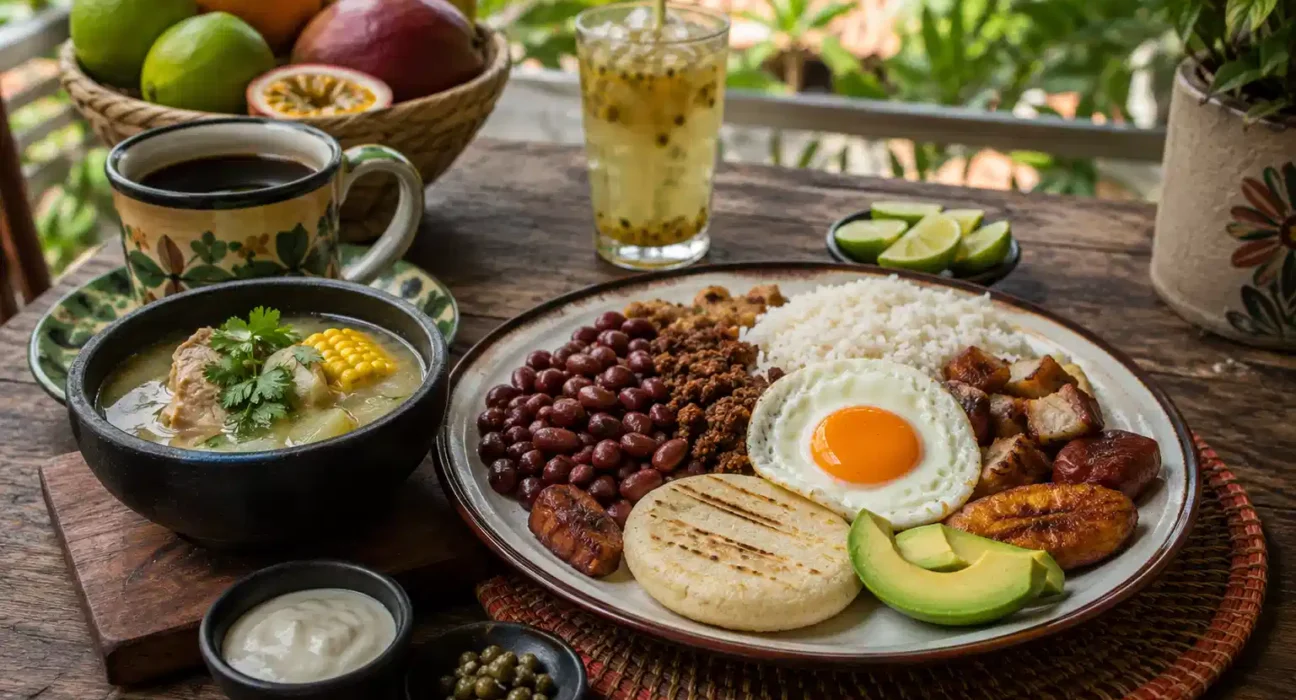
Bandeja Paisa is one of the most popular traditional Colombian dishes. It is a large and substantial plate that often contains beans, white rice, ground meat, chicharrón, fried egg, plantain, avocado, and an arepá. The exact mix may change, but the dish is definitely linked to Antioquia and the Paisa region.
Why it’s worth a try: It offers a taste of the hearty cooking of the Andean region of Colombia for first-time visitors.
2. Ajiaco

Region: Bogotá and the Andean highlands
Ajiaco is a traditional Colombian soup, which is prepared with chicken, several potato varieties, corn, and guascas. It is especially linked to the Cundiboyacense highlands, in which Bogotá is included.
The potatoes add a lot of body to the soup, and guascas give the soup a distinct herbal character. Usually served with cream and capers, avocado, and rice.
Why give it a try: One of the most evident proofs of the regional food culture in Bogotá.
3. Arepas

Region: Throughout Colombia
Arepas actually warrant their own spot on the list since they’re not a uniform dish. In Colombia, there are versions of these that may vary in thickness, preparation, filling, and ingredients.
Some arepas are simple corn cakes served as side dishes; others have cheese, eggs, meat, or some other filling.
Why bother: Arepas are an easy way to taste regional variations of Colombian cuisine.
4. Colombian Empanadas

Region: Throughout Colombia
The empanada is usually filled with seasoned meat, potatoes, or other locally available fillings and topped with a corn-based dough. They are often deep-fried and sometimes eaten as street food.
Colombian empanadas are similar to other empanadas found in other parts of Latin America, but they tend to have a corn-based exterior.
Why they’re worth it: They are cheap, easy to find, and are a great introduction to Colombian street food.
5. Sancocho

Region: Multiple regions
Sancocho is not just a recipe, but a general Colombian custom. Regional variants may feature chicken or beef, pork or fish, plantains or cassava or corn or potatoes.
Sancocho varies in recipe across each region, so experiences at each location can be quite different.
Why do it: It demonstrates the variations of a simple cooking practice into regional cuisines.
6. Lechona

Region: Tolima
Lechona is a traditional dish of the Tolima department. It is traditionally a whole roasted pig filled with a spiced mixture, often consisting of rice, peas, onions, and spices.
It is especially connected with celebrations and gatherings of a massive magnitude.
Why bother: It’s a significant example of festive food in Colombia.
7. Tamales

Region: Multiple regions
Tamales are very varied from region to region in Colombia. Typically formed into a corn dough, they are stuffed with various ingredients such as meat and vegetables and then wrapped and steamed.
The form, wrapping, and filling may vary by region, as well as the way it is prepared.
Why try: No one particular “Colombian tamale”, so regional variants are particularly fascinating for travellers.
8. Patacones

Region: Throughout Colombia
Patacones are slices of green plantain that are cut, fried, flattened, and fried again until crisp. These can be enjoyed as a side dish, appetizer, or whatever other toppings are used.
They are particularly prevalent with fish, meat, beans, and other Colombian foods.
Why try it: They’re easy, but have great significance in the Colombian cuisine.
9. Arepa de Huevo

Region: Colombia’s Caribbean coast
Arepa de huevo is a Caribbean Colombian specialty that consists of frying a corn arepa and filling it with an egg. Seasoned meat is added to some versions.
It is especially favored as a breakfast or street food along the Caribbean coast.
Why try: One of the most unique versions of the Colombian arepa in the Caribbean region.
10. Fried Fish With Coconut Rice and Plantains

Region: Caribbean coast
Seafood is an important part of the Caribbean coast cuisine. A typical pairing is fried fish, coconut rice, and fried or cooked plantains.
The sweetness of the coconut complements the savory flavour of the fish and plantains.
Why to try: It provides tourists with a nice insight into the Caribbean identity of Colombia.
11. Cazuela de Mariscos

Region: Caribbean coast
Cazuela de mariscos is a seafood dish that is cooked with various types of seafood, all served in a rich sauce or broth. It may contain shrimp, squid, mussels, fish, and other seafood, depending on the preparation.
The dish mirrors the richness of seafood that’s found along Colombia’s Caribbean shores.
Why try it: It’s an option for visitors seeking to discover Colombia away from the typical Andean cuisine of beef and other meats.
12. Carimañolas

Region: Caribbean coast
A fried snack made from cassava that is usually stuffed with spiced meat or other fillings, known as carimañolas. Cassava dough gives the cake a crisp texture on the outside and a soft texture on the inside.
They’re also a popular ingredient in Caribbean Colombian dishes and are used as a snack or breakfast food.
Why try it: They mix the traditional main ingredient (cassava) with the taste of Caribbean cooking.
13. Arroz Atollado

Region: Valle del Cauca
Arroz atollado is a traditional Colombian dish from Valle del Cauca that features a rice dish topped with a variety of beans. Made from rice and a blend of meats and other ingredients, it is a soft, delicious, and juicy dish.
It is especially linked to the cuisine of Cali and the region.
Why try it: It brings visitors a taste of the unique food culture of the southwest region in Colombia.
14. Pusandao

Region: Pacific coast
Pusandao is a traditional dish of fish or other local ingredients cooked in coconut milk, yuca, plantain, and potatoes in the Pacific region of Colombia.
The dish is a nod to the Pacific region’s rich association with seafood, coconut, and local produce.
Why bother: It allows visitors to try a part of Colombian cuisine that may not be on every tourist’s radar.
15. Pantarashca

Region: Amazon
Pantarashca is a traditional Amazonian fish recipe containing local ingredients. The fish is wrapped and cooked in a traditional way, where the ingredients and the cooking methods vary from one region to another.
It represents the food way of life of the communities of the Amazonian region of Colombia as well as the significance of fish in river life in the region.
Why you should try it: It proves that Colombian food goes beyond the well-known dishes of Bogotá, Medellín & the Caribbean coast.
Colombian Food by Region
If you want to learn about Colombian food, there is no better way than studying its origins. The geographical zones of Colombia are the Andes, Amazon, eastern plains, Caribbean, and Pacific coast. Different ingredients, cooking techniques, and food traditions have developed throughout the country in these environments. The Ministry of Culture of Colombia also identifies the traditional foods based on the culinary traditions of each region of the country, not on the basis of what would qualify as the country’s cuisine.
Andean Region
Many of Colombia’s main cities, like Bogotá and Medellín, are in the Andean region. Potatoes, corn, beans, rice, meat, and hearty soups are common ingredients in Highland cooking. The cooler mountain climate has influenced dishes that are substantial and frequently hot.
Guasca and corn are used to create a soup known as ajiaco, which is particularly popular in Bogotá and is also prepared with potato and chicken. On the other hand, bandeja paisa is a large meal from Antioquia, made up of beans, rice, meat, chicharrón, egg, plantain, avocado, and arepa.
Arepas are also significant in the Andean region’s food culture. Depending on the region, different types are prepared and shaped, which means that different types might be found to be slightly different in different areas of Colombia.
Caribbean Region
There are very different foods found along Colombia’s Caribbean coast compared to those found in the highlands. Key ingredients include fresh seafood, coconut, plantains, cassava, and corn.
A typical coastal dish is fried fish, coconut rice, and plantain. It’s a delightful mix of savory seafood, slightly sweet coconut rice, and the earthy sweetness of plantains. The fried corn arepa, loaded up with an egg, is also a specialty of Caribbean Colombia.
Other parts of the food culture in the region include street foods like carimañolas, which are made from cassava, and other snacks made from corn.
Pacific Region
There are also local culinary traditions on the Pacific coast, influenced by the coastline and local history and culture. Local ingredients like fish, seafood, coconut, plantains, cassava, etc. are of great importance.
Pusandao is an example of this. According to Colombia Travel, it is a version of the dish with fish, coconut milk, yuca, potatoes, and plantains. Afro-Colombian culinary traditions are also evident in the region’s cuisine.
The Pacific area is not quite as popular as places like Cartagena and Bogotá in terms of international tourist visits, so the food here can be a more offbeat taste of Colombian dishes.
Amazon Region
The food of the Amazon has a strong link to the rainforest environment and the people living in the area. Local foods such as river fish, cassava, and plantains are widely used in traditional dishes.
For instance, Pantarashca is a traditional Amazonian method of cooking fish using local cooking methods. The importance of indigenous culinary knowledge and traditional cooking practices of the Amazon is highlighted by Colombia Travel.
Food in this area can taste very different, however, from the foods that are more closely linked to the food of Colombia’s main cities.
Orinoquía and the Eastern Plains
The culinary culture of the Orinoquía, or Llanos, is closely linked to the extensive grasslands and to the cattle ranching culture of the area.
Beef is also of great importance to local cuisine. One of the most popular dishes of the plains is called mamona, or ternera a la llanera. It is traditionally a meal of young beef grilled over an open fire.
The cuisine is the result of the lifestyle and agricultural customs of the Llanos, rather than the seafood cuisine which is common along Colombia’s coast.
Insular Region
Some of the islands of Colombia belong to the insular region: San Andrés and Providencia. Food traditions are influenced by the islands’ location and access to seafood in the Caribbean region.
Island cooking includes fish, seafood, coconut, and tropical ingredients. Its cuisine must be given its own texture and should not be considered merely a variant of Colombian mainland cuisine.
Why Regional Food Matters in Colombia
One of the most interesting aspects of Colombian food is the difference in regions. For a visitor who only eats in the city of Bogotá, they are only sampling one aspect of the country’s culture.
The Ministry of Culture’s traditional food research showcases the relationship of Colombian traditional food with the geography of the country, as well as its culture, history, and local food practices. It has thousands of documented traditional recipes in its national inventory and a helpful glimpse into this culinary variety.
That’s why, when dining out in Colombia, location can be as crucial as the food you eat. If you want to find out a little more about Colombian food, you can try ajiaco in Bogotá, Caribbean seafood on the coast, or Amazonian preparations in the country’s southern rainforest region.
Colombian Food by Region
Because of the different geographical, climatic, and cultural regions in Colombia, the cuisine varies from area to area. Each region of the Andes, Caribbean coast, Pacific coast, Amazon, eastern plains and islands has its own ingredients and cooking methods.
- Andean Region: Potatoes, corn, beans, rice, meat, and soups are common. Ajiaco is strongly associated with Bogotá, while bandeja paisa is a signature of Antioquia.
- Caribbean Region: Seafood, coconut, plantains, cassava, and corn are widely used. Fried fish with coconut rice and plantains and arepa de huevo are notable examples.
- Pacific Region: Fish, seafood, coconut, and plantains are important. Pusandao is one traditional example.
- Amazon Region: Local river fish, cassava, plantains, and Indigenous cooking traditions shape the cuisine. Pantarashca is one example.
- Orinoquía: Beef and cattle-ranching traditions influence the food, with mamona being a well-known regional dish.
- Insular Region: The Caribbean islands have food traditions centered on seafood, coconut, and tropical ingredients.
It is this regional variety that makes Colombian cuisine more than just a list of popular dishes. It’s worth trying some local specialties from the regions that they came from to really taste the country to the fullest.
Colombian Street Food
Street food is an excellent option to try local flavors without having to order a main course in Colombia. Some of the popular street-food items of Colombia are arepas, empanadas, arepa de huevo, carimañolas, and obleas.
Popular Colombian Street Foods
- Empanadas: Fried corn-dough pastries filled with ingredients such as meat and potatoes.
- Arepa de huevo: A fried corn arepa filled with an egg, a specialty of Colombia’s Caribbean coast.
- Carimañolas: Fried cassava pastries commonly filled with meat.
- Obleas: Thin wafers served with sweet fillings such as arequipe.
- Arepas: Regional corn cakes that can be eaten plain or with different fillings.
Colombian Fruits You Should Try
Colombia’s tropical climate produces an abundance of fruit, some of which can be found nowhere else. Lulo, passion fruit, guanábana, granadilla, tree tomato and corozo are consumed as juices, desserts and snacks.
Lulo is tart and citrus-flavoured, particularly in drinks. The flavor of guanábana is creamy and sweet, while maracuyá (passion fruit) is sweeter and tart. A great way to taste Colombia’s tropical fruits is to try fresh fruit or a freshly pressed juice.
Popular Colombian Drinks
Colombian Coffee
Coffee is among the most widely known agricultural products of Colombia as well as an integral part of its culture. The Andean region is especially linked to the traditions of the coffee growers.
Aguapanela
Aguapanela is the traditional beverage that is prepared by dissolving the unrefined cane sugar called panela in water. It can be made hot or cold, and sometimes mixed with lime.
Lulada
Lulada is a refreshing beverage, which is basically composed of lulo, water, and sugar. It is particularly associated with the Valle del Cauca region.
Fresh Fruit Juices
It is common to find fruit drinks that have been freshly prepared in Colombia. Often used tropical fruits like lulo, guanábana, and passion fruit provide a quick way for travelers to sample flavors they may not be familiar with.
Colombian Desserts and Sweets
Milk, sugar, coconut, fruit, and panela are commonly used ingredients in Colombian desserts. Common varieties include obleas, cocadas, natilla, arequipe and cuajada con melado.
Obleas are thin wafers that are often filled with sweet stuff like arequipe. Cocadas are coconut sweets, and natilla is an old custard-like dessert which is particularly favoured in the Christmas season. The combination of fresh curd cheese and a sweet panela syrup is called Cuajada con melado.
What Does Colombian Food Taste Like?
Food in Colombia isn’t uniform, as each region has its own distinct recipes. Pots of potatoes, corn, beans, rice, and meat are common ingredients in Andean cuisine, while seafood, coconut, plantains, and cassava are more heavily used in the coastal regions. Tropical fruits also boost sweet and tart taste to drinks and desserts.
It’s important to remember that Colombian cuisine can be as indulgent and satisfying as it can be full of fresh tropical flavors. Rather than trying one national dish, visitors should taste different regional dishes.
What Do Colombians Eat for Breakfast, Lunch, and Dinner?
Ropa, arepas, eggs, bread, cheese, and coffee make up breakfast, which may vary depending on region and family.
Lunch can be a large meal and may consist of Soup followed by a main course of Rice, Beans, Meats, Plantains, or Vegetables.
Dinner may be lighter; arepas, eggs, soups, or local dishes may be used. Families and areas have natural variations in eating habits.
Best Colombian Foods for First-Time Visitors
If it’s your first time in Colombia, begin with foods from various regions of Colombian cuisine:
- Bandeja Paisa — Antioquian specialty
- Ajiaco — Bogotá and the Andes
- Arepas — found throughout Colombia
- Empanadas — popular street food
- Sancocho — regional soup tradition
- Arepa de Huevo — Caribbean specialty
- Fried Fish with Coconut Rice — Caribbean coast
- Lechona — traditional Tolima dish
This collection features a variety of flavors from the Andes, Caribbean, and local Colombian cuisine.
Where to Try Colombian Food
Ajiaco, tamales, and other Andean delicacies are worth a try in Bogotá. Bandeja paisa and Antioquian cuisine are both very characteristic of Medellín. Along the Caribbean coast, you can find seafood, coconut rice, fried fish, and arepa de huevo in some of the city’s restaurants.
Those planning a tour to the Valle del Cauca can taste local dishes like arroz atollado, while visitors to the Pacific and Amazon regions will get to enjoy lesser-known dishes. In Colombia, traditional foods differ in each region, so Colombia Travel suggests visiting the different regions to find out about the foods that are prepared in various ways and with different ingredients.
Is Colombian Food Vegetarian-Friendly?
There are options for vegetarian travellers in Colombia too, but they should look into the ingredients. Some cheese-based dishes, rice, beans, plantains, vegetables, and arepas can be used to get meat-free options.
Some beans, soups, and other dishes may, however, contain meat, meat stock, or animal fat. It’s best to check on ingredients prior to ordering.
Tips for Eating in Colombia
Instead of ordering the same food items everywhere, try out some regional dishes.
- Go to local markets to taste Colombia’s diversity of fruits.
- Before vacationing in Spain, learn at least a few Spanish words for food.
- Inquire about ingredients when on a special diet.
- When feasible, explore local delicacies from their respective areas.
- Besides, don’t expect Colombian cuisine from just one city because there are significant differences from one region to another that form part of the country’s culinary culture.
Conclusion
Colombian food is regional and not one unique type of food. Each region has its own unique dishes, ranging from the hearty Andean dishes like bandeja paisa and ajiaco, to the Caribbean seafood, the Pacific specialties, the various tropical fruits and the Amazonian preparations.
The best advice for travellers is to eat local food wherever they go. A tour of the region brings, in addition to the cuisine of famous foods, a greater understanding of Colombia’s geography, culture and cuisine.
You may also like: Tropical Foods Ice Cream Recall: Affected Products & FDA Update
Barn Cat Dry Cat Food 32lb Bag: Price, Ingredients, Reviews & Buying Information
Frequently Asked Questions
What is Colombia famous for in food?
Some of Colombia’s well-known dishes include bandeja paisa, ajiaco, arepa, empanada, sancocho, and lechona, and the country is famous for its coffee and diverse tropical fruits.
What is the most famous Colombian food?
Bandeja paisa is one of the most internationally known traditional dishes of the country, and arepas and ajiaco are strongly linked to Colombian cuisine.
What are five traditional foods in Colombia?
There are 5 popular ones: bandeja paisa (also known as bandeja criolla), ajiaco, arepas, sancocho, and lechona.
Is Colombian food spicy?
Food is diverse in Colombia, following each region and dish. Don’t assume that all traditional dishes are also as hot. For extra flavour or spice, sauces and condiments are used.
What is a typical Colombian breakfast?
Breakfast is varied, but sometimes includes arepas, eggs, cheese, bread, and coffee.
What Colombian street food should you try?
For a wide overview of Colombian street food, try empanadas, arepas, arepa de huevo, carimañolas, and obleas.
What fruits are popular in Colombia?
The common fruits include lulo, guanábana, passion fruit, granadilla, tree tomato, and corozo. A lot are consumed fresh or added to beverages and juice.
What should you eat first in Colombia?
The bandeja paisa, ajiaco, arepas, empanadas, and a Caribbean seafood stew are good alternatives for first-time visitors to learn about various Colombian food traditions.